
Nov 22, 2026 · @Mitchell Efros
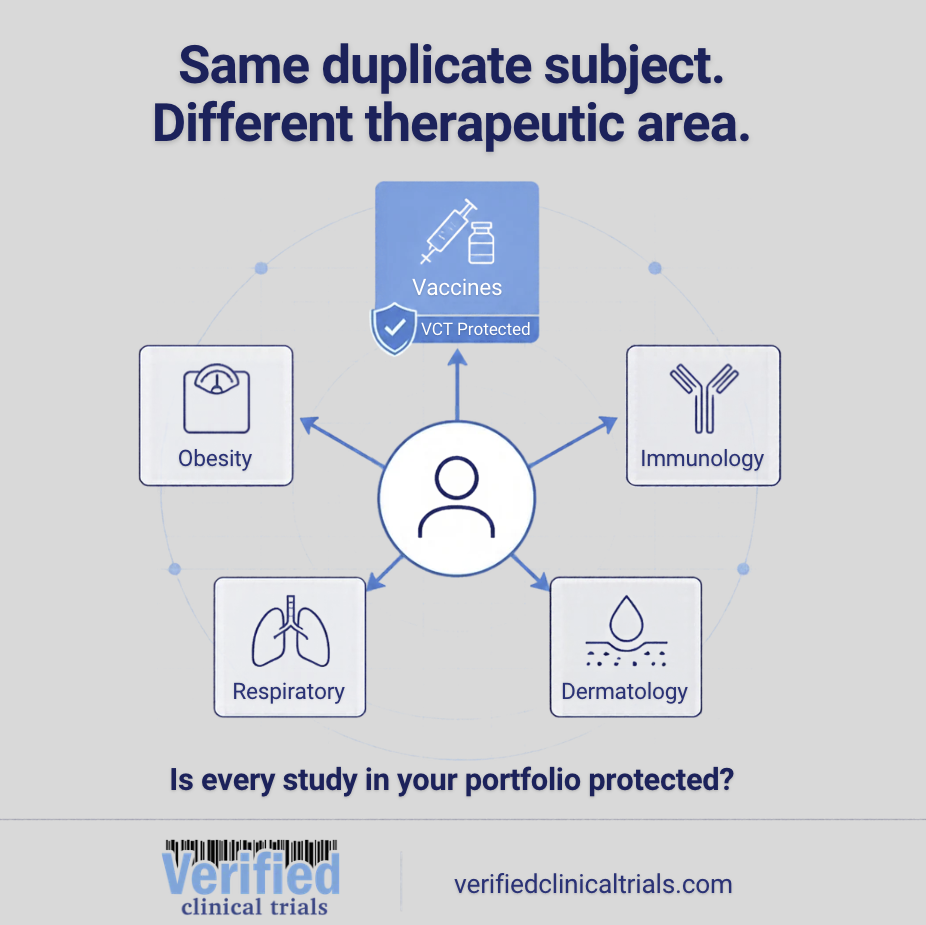
Duplicate subjects in clinical trials don’t stay in one place. If Verified Clinical Trials is catching them in your vaccine or obesity studies, those same subjects are trying to enroll in your immunology, respiratory and dermatology trials.
We see this pattern often. A sponsor adds VCT to one program, usually where the problem first became visible, and the results are clear. Then the next study in a different therapeutic area starts without it, as though the problem belonged to the first program alone. It doesn’t.
Subjects don’t stay in one therapeutic area
Professional subjects in clinical trials, the people who enroll in study after study, aren’t loyal to an indication. They go where studies are enrolling, where the visits fit their schedule, and where the stipend is worth their time.
Finding the next study is easy. Public websites such as ClinicalTrials.gov and the NIH’s Finding a Clinical Trial page let anyone search for studies by condition and location, and these are exactly the sites subjects use to look for their next trial.
The subject who screened for a GLP-1 obesity trial in the spring may screen for a vaccine study in the fall and an atopic dermatitis study after that. Many of these studies have broad eligibility criteria, which makes it easy for the same person to qualify again and again.
Sites don’t stay in one therapeutic area either
Many research sites run vaccine, metabolic, respiratory, dermatology and immunology studies under the same roof or within the same network. They recruit from the same local population and often from the same subject database.
So the duplicate subject problem a sponsor found in its vaccine program lives at the same sites, in the same cities, that are now enrolling its asthma or psoriasis study. The only thing that changed is whether anyone is checking.
You already have the evidence
A sponsor using VCT in one therapeutic area has its own proof. It has seen how many subjects were flagged at screening and what kinds of protocol violations were prevented.
Nothing about those findings is specific to the indication. They describe subject behavior and site geography, and both carry over to the rest of the portfolio. Leaving the other studies unprotected means accepting, in those trials, the same risk that was considered unacceptable in the first one.
Exclusion criteria cross therapeutic areas too
Some exclusion criteria reach well beyond a single indication. A recent investigational product, a biologic with a long washout, or a vaccine received within a set window can each disqualify a subject from an unrelated study.
VCT checks participation across studies, sponsors and indications. A subject in your obesity trial can be stopped from enrolling in your immunology trial, and the other way around. The more of a portfolio that participates, the more of these conflicts are caught before randomization.
From one study to a portfolio standard
The sponsors that get the most from VCT stop deciding one study at a time. They treat verification as a portfolio standard, write it into the protocol template and budget for it from the start.
If it is working in one of your therapeutic areas, you already have the proof. The real question is why your other studies should go without it.
To learn how VCT helps prevent duplicate subjects in clinical trials and protects your portfolio from professional subjects in clinical trials, visit www.verifiedclinicaltrials.com or contact us.